How to Maximize the Impact of Your Co-Op Marketing Investment
The problem isn’t that co-op marketing has lost value; it’s that the model hasn’t evolved with modern marketing expectations. As a result, co-op dollars go unused or are wasted due to inefficiency and ineffectiveness. For ag marketers working to prove ROI and maximize budget efficiency, co-op programs need a reset: more transparent structure, digital tools, shared accountability and measurable results.
When executed strategically, co-op funding can do more than build brand awareness. It can strengthen dealer relationships, drive preference and differentiation, and improve measurable sales performance.
Note: Co-op programs can be executed across a range of channel partners, including dealers, retailers, distributors or input suppliers. Throughout this article, we use the term “dealer” to represent all such partners for clarity and consistency.
1. Set Clear Objectives, Requirements and KPIs
For years, co-op dollars were spent on community sponsorships, small newspaper ads or event giveaways, efforts that built goodwill but lacked measurable impact and clear use of co-op funds. In 2026, that’s no longer enough.
Successful programs now define clear goals from the start such as click-through rates, engagement, lead generation or sales impact and tie them to transparent KPIs. Shared dashboards let both brands and dealers see results in real time and adjust on the fly. With resources like Farm Journal’s Ad Insights Tool, marketers can track performance across every touchpoint and identify which tactics deliver the highest ROI. This kind of visibility transforms co-op from a static budget to a dynamic performance driver.
2. Establish Joint Buy-In and Shared Accountability
The most effective programs function as partnerships, not transactions. Both brands and dealers have skin in the game and visibility into the outcomes. By aligning on performance metrics and shared reporting, both sides gain the insight needed to refine creative, shift budgets and scale what’s working. This transparency builds trust, encourages participation and transforms co-op from a “use it or lose it” fund into a shared growth opportunity.
3. Define and Ensure Clear Performance Parameters
Modern co-op programs are shifting from entitlement to accountability. Instead of automatically allocating funds, leading brands are linking participation to measurable performance. Dealers that activate campaigns and deliver proven results earn greater support while inactive or inconsistent partners risk losing future eligibility.
Defining clear performance parameters ensures everyone knows what success looks like. Programs should establish specific goals such as engagement, lead generation or sales lift and require consistent reporting to verify outcomes. This clarity helps both brands and dealers invest funds strategically and adjust tactics based on real performance data.
When every dollar is tied to a measurable result, accountability becomes part of the culture. Dealers are motivated to plan and execute with purpose and brands gain confidence that their investment is driving impact where it matters most.
4. Develop Simple, Clear Program Guidelines
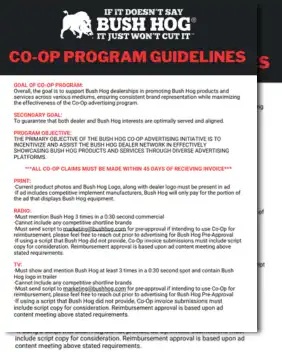
Bush Hog’s 2024 Co-Op Program is a strong example of how clear structure and defined media standards can drive consistency and participation. Dealers earn co-op credit based on shipment volume with specific requirements for each channel such as mentioning Bush Hog three times in a 30-second radio spot and submitting claims within 45 days of invoicing. The program’s tiered accrual model and detailed approval process reinforce brand integrity while giving dealers a transparent and easy-to-follow framework for using funds effectively. (Bush Hog Co-Op Program, 2024)
When guidelines are clear, workflows are streamlined and assets are easy to access, dealer participation rises. Simplified, technology-enabled systems reduce friction, accelerate approvals and help both brands and dealers achieve measurable results from every marketing dollar.
5. Localize Your Program for Greater Impact
Local dealers know their markets better than anyone, and that local insight is one of co-op’s most significant advantages. Yet many programs fail because they don’t give partners the flexibility to adapt messaging and program elements to account for local realities.
Editable, brand-approved templates allow dealers to highlight regional crops, local testimonials or field events while maintaining brand consistency. Providing plug-and-play creative assets, digital training and co-branded playbooks empowers partners to execute confidently. Producers connect with familiar faces, not faceless campaigns, local storytelling builds trust, credibility and performance.
The Future of Co-Op: Digital, Data-Driven and Measurable
Today’s co-op marketing will be defined by transparency and technology. Digital targeting and automation now make it possible to see exactly how each campaign performs from impression to conversion. Brands and dealers can share data, track regional trends and collaborate on strategy in real time.
A growing number of manufacturers are already making this shift. For example, KIOTI has a Co-op Advertising Program that enables dealers to earn accrual funds equal to 2% of prior-year purchases, with reimbursement available for both traditional and digital advertising. Dealers are encouraged to invest in online campaigns, social media and video promotions that can be tracked for engagement, leads and conversions, turning what used to be a static reimbursement model into a performance-driven partnership.
Leading ag marketers are also rethinking creative. Instead of one-size-fits-all assets, they’re co-developing local content, short videos, case studies and on-farm demonstrations that show product value. These stories connect national branding with community trust, creating the balance every marketer is striving for.
Most importantly, measurement is no longer optional. Every funded effort should have traceable outcomes tied to KPIs. As technology bridges the gap between visibility and sales data, marketers can finally quantify co-op’s full impact.
The Takeaway for Ag Marketers
Co-op marketing isn’t a legacy tactic, it’s a valuable performance tool waiting to be modernized. For marketers navigating tighter budgets and higher expectations, it offers a unique opportunity to extend reach, strengthen dealer relationships and prove ROI at scale.
The key is treating co-op like a modern marketing investment: structured, digital, measurable and aligned to business outcomes.
In 2026, the brands that modernize their co-op strategy will stand apart. Not because they spend more, but because they spend smarter.