What Ag Suppliers Must Know to Stay Ahead in a Rapidly Changing Industry
Agriculture is in one of its most consequential periods in decades. Today’s farm economy is under prolonged financial strain that is reshaping how growers make decisions, a moment economists describe as “not a collapse, but a grind.” (AgWeb) In this environment, the rules for marketers and sellers are changing fast. These are not short-lived trends or cyclical headwinds. They are structural shifts redefining who buys, how they buy and what they expect from the partners they trust.
Winning in this environment requires more than campaigns or product expertise. It requires clarity on the forces shaping producer behavior and confidence in engaging ag buying groups that increasingly look and act like enterprise organizations.
Below are the three forces every ag supplier, manufacturer and service provider must navigate, and the specific actions marketers and sellers should take to strengthen relationships, increase discoverability and win business in today’s market.
In this environment, marketers need clarity, data and intelligence to navigate what comes next.
Inside the Reality of Today’s Farm Operation
To understand how quickly agriculture is changing, picture a modern farm. In one season, the family is watching cattle prices climb, grain prices soften and input costs shift. A decision in the cow herd affects whether they invest in a new sprayer. A change in grain markets influences what technology they buy next. These cross-pressures are becoming the norm as operations diversify and become more complex.
Consolidation is also accelerating. Larger operations are taking on more acres and greater responsibilities, while consumers are demanding greater transparency and trust in the food chain. Every part of agriculture influences another. What happens in the field affects the supply chain, and what happens in the supply chain shapes decisions back on the farm. Agriculture now functions as a single ecosystem, not a collection of separate markets.
With this new reality, ag sales and marketers must adapt their strategies, understand the mindset, needs and operations of each farm and evolve the programs and tactics they use to generate and expand relationships and revenue.
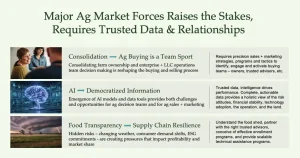
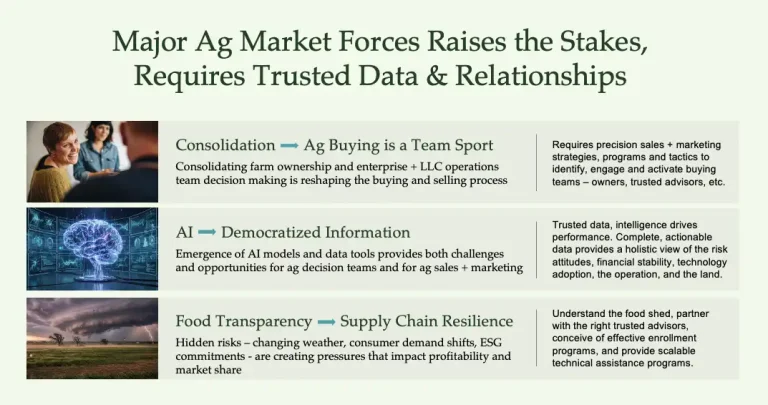
1. Consolidation Is Changing Who Influences and Makes Decisions
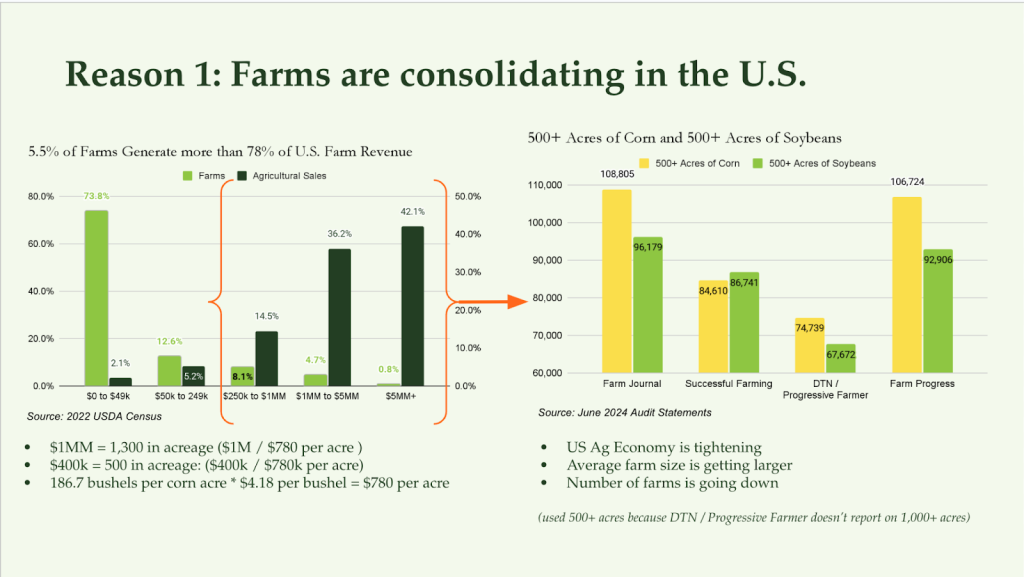
Farms are consolidating and the direction of the industry is unmistakable. Scale is a priority for success, as 500+- and 1,000+-acre growers continue to expand their footprint and influence. The data support what we already see happening in the field. Average farm size is increasing, the total number of farms is going down and a small group of operations now generate the majority of U.S. farm revenue.
With nearly 300 million acres set to transition in the next two decades (American Farmland Trust) it is essential to understand who will be operating that land and influencing the decisions about the providers and suppliers they work with. Large-scale growers are driving consolidation and they will hold even more buying power in the years ahead.
For ag marketers, this level of consolidation means your customers have greater buying power and make decisions in very different ways. More and more, Farms are less like small owner-operated units with one person calling the shots. Instead, they look more like enterprise organizations with roles, operating budgets and internal stakeholders who all shape the purchase process. CEOs, herd and crop managers, agronomists, nutritionists, veterinarians, financial officers and trusted advisors are now at the buying table. Your audience is no longer a single farmer. It is an entire ecosystem where each operation represents major acreage, multiple product categories and significant annual spend.
How Consolidation Changes the Playbook for Ag Marketing and Sales
This shift requires moving from speaking to a single decision-maker to understanding the complete decision environment. Farms rely on multiple roles, each with its own priorities and biases that influence outcomes. Messaging must align to these roles, insight must reflect how modern operations actually run and data must go deeper than past assumptions. Broad rural targeting wastes investment by missing much of the buying group that can drive growth, and channel messaging that does not match producer needs leaves out influential voices in that group. Content that is not built for online research, with clear summaries and data points, will not move through internal meetings where choices are made. In this environment, the brands that refine their data, strengthen their messaging and create content that is easy to use across the buying group will gain meaningful ground.
2. AI Isn’t Replacing Marketers. But It Is Raising Expectations.
AI has made information abundant and instantly accessible. Farmers, suppliers, dealers and food companies can prompt a tool and generate content, comparisons or recommendations in seconds. This creates a common misconception that expertise is no longer required. In reality, AI is only as reliable as the quality of the information and data behind it, and that is precisely where ag suppliers can lead.
Here are recent cross-industry collaborations that are helping accelerate AI adoption in agriculture:
- Land O’Lakes and Microsoft partner to accelerate AI innovation in agriculture
- WinField United Deploys Artificial Intelligence To Improve Its Agronomic Adviser Retention
- Microsoft and Bayer Aim To Accelerate and Unlock Digital Agriculture
Your advantage in an AI-assisted world is trust. Buyers can quickly tell the difference between generic answers and insight grounded in real conditions, real performance and real outcomes. You are no longer competing with the volume of AI-generated content. You are competing on the credibility of your data, the usefulness of your insight and the speed at which you help buyers cut through noise.
Your role is to anticipate and answer the buying group’s questions based on their needs, biases and decision criteria, not just your products. This level of relevance is what sets trusted suppliers apart.
Why Credibility and Expertise Matter More in an AI-Driven Market
As AI reshapes how information is created and consumed, your expertise must be easy to find. This shift raises new expectations for every marketer and seller, because AI can only perform as well as the data on which it is trained. Any gaps in your understanding of the operation put your brand at an immediate disadvantage, and content that is not present on authoritative sites with strong AI-driven engine increases the likelihood that buyers receive answers built from competitor data rather than your own. Strong discoverability across search answer engines, audience targeting and location-based strategies keep your brand in front of buyers who are already seeking solutions. When trusted data, human expertise and discoverability work together, brands do not lose relevance in an AI-driven landscape but strengthen their position within it.
3. Regenerative Agriculture Is Becoming a Business Mandate
Regenerative agriculture has moved into the center of business strategy for ag operators and owners because consumer expectations, food company commitments and climate volatility now converge at the farm gate. It is driven by consumer demand, supply chain pressure and the need for long-term resilience. Consumers want confidence in the food they buy, and food companies are responding with measurable targets that shift expectations back to the farm.
The stakes behind these expectations are rising. A 2021 survey from Interos found that the average cost of a supply disruption in U.S. companies is $ 228 million per event, well above the global average of $ 184 million. These disruptions include extreme weather, climate shocks and supply instability, all of which affect agriculture more than most industries. When a single event can carry this kind of cost, regenerative practices become a tool for risk management and business continuity.
For producers, regenerative programs offer new income streams and potential market advantages, but the landscape can be confusing. Requirements change often, verification is complex and programs vary widely. Trusted advisors help farmers identify which programs fit their operation and where the actual value lies. This is also where precise comparative data becomes powerful. Vendors that provide information showing how specific practices improve soil compaction, water utilization, stand counts or livestock performance gain a meaningful advantage in both marketing and sales conversations.
How Regenerative Expectations Are Reshaping Decisions Across the Value Chain
You can simplify a crowded regenerative landscape and show how sustainability connects consumer expectations, food company requirements and farm-level opportunity. Producers want clarity and value, and everyone wants trusted data that proves what works. Every input, animal health and technology company is now competing with food companies for the same limited capacity that farmers have to change practices. At the same time, rising input costs and softening commodity prices mean producers are spending less time on yield maximization and more time identifying practices that reduce financial risk. The brands that win will be the ones that make regenerative agriculture understandable, credible and clearly linked to business performance across the value chain.
Today’s Ag Market Demands Clear Insight and Trusted Expertise
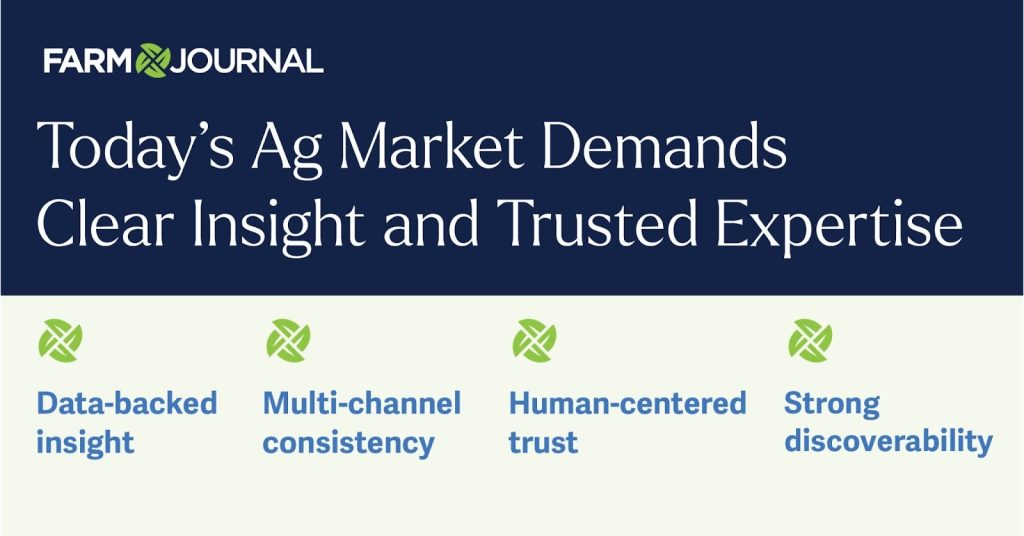
Across the entire ag value chain, the expectations for ag suppliers and providers are rising. Farmers and producers are making decisions that are more data-driven, collaborative and accountable, and they must balance speed with quality as they determine when, what and how to invest. Providers and suppliers are selling into buying groups that include trusted advisors, family members and business stakeholders. Winning in this environment requires four priorities that match how modern producers search, evaluate and decide:
1. Strong discoverability to make the consideration list, win early
Your brand must be easy to find, understand and validate because buyers build their lists fast. Search behavior, social signals and AI tools all rely on structured information and clear value messaging. If your content is not present, accurate and optimized, you are simply not in the running.
2. Data-backed insight included in your content and communications
Producers want clarity they can trust because every decision carries operational and financial risk. Proof points, comparisons and performance data help buyers evaluate options with confidence. This reduces uncertainty and positions your brand as the safer, smarter choice.
3. Multi-channel presence and consistency to increase your solution visibility
Buyers move between broadcast, digital, streaming, social and in-field conversations and they expect the same message everywhere. A steady, unified presence reinforces who you are and what you stand for. It keeps your brand top of mind when decisions are made.
4. Human-centered trust to engage and make a meaningful connection
With AI generating more content than ever, credibility is the differentiator. Producers respond to real expertise, operational context and an authentic understanding of their challenges. Showing that you genuinely understand their world builds trust that no algorithm can replace.
Your role is increasingly strategic as you help customers navigate complexity with trusted information and a full view of the decision environment. Ag sellers and marketers cannot control the forces reshaping agriculture, but they can align with them.